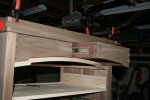
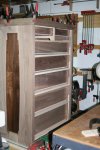
G&G Inspired Chest of Drawers - Build Thread

SWEEEET!! just what i needed today glenn:) now some refresher questions,, on the dust dividers you glued and screwed them? to the sides.. how are you allowing for movement in the sides by doing that? or are you figuring the inner panels will allow the movement to come from both directions?

now way back in the beginning you showed us your diagonal measuring rig.. where did you get the clamps at for that?
and you have done a excellent job on this glenn,, those drawers on top do it all for the piece in my opinion..
 
SWEEEET!! just what i needed today glenn:) now some refresher questions,, on the dust dividers you glued and screwed them? to the sides.. how are you allowing for movement in the sides by doing that? or are you figuring the inner panels will allow the movement to come from both directions?

Screwed and glued to the side for the first 3" or so at the front, screws into the sides through overized holes at rear to allow for front to back movement of the sides. This is similar in function to rear floating tenons in more traditional web frames. Front to back is the primary location of movement in this design. Due to the side-panel glue-ups I effectively have a 22" x 54" panel on each side, grain running the long dimension. The goal of the design is to create a relatively stable front frame and divider to drawer front area (to maintain a consistent look throughout the year) while allowing for expansion/contraction toward/away from, the rear. It looks good on paper but, time will tell if I truly have been successful.

now way back in the beginning you showed us your diagonal measuring rig.. where did you get the clamps at for that?and you have done a excellent job on this glenn,, those drawers on top do it all for the piece in my opinion..

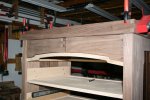
Thanks for the kind words Larry. Let me look back . . . Ah, found it (man, I have posted a lot of stuff on this build and it still going to take 4 months to get done :eek:), I think you mean these. They are Lee Valley 'bar gauge heads'. I had a shop made version with a couple short carriage bolts and wing nuts along with two pieces of hardwood with slots cut in them. Very serviceable but, I found I use them for so many things I bought the commercial version. I added a second set to my wish list and got them for one event of another awhile back so I have short ones for drawers and long ones for carcasses and a few odd lengths of "sticks" for whatever happened to come along.

Now that the 'unusual' drawer fitting is done things are going to move right along for awhile.

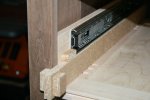
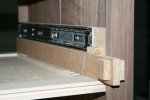
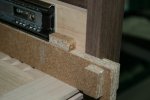
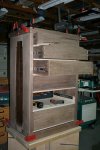
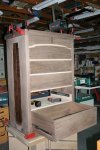
CoD drawers-more (4).jpgCoD drawers-more (3).jpg

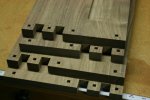
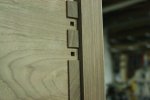
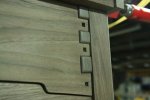
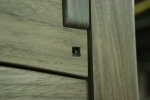
Today I am pretty much a square hole factory.

CoD drawers-more (2).jpgCoD drawers-more (1).jpg
 
Last edited:
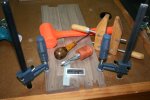
Almost forgot to show the super-custom-highly-refined drawer glide alignment tool :D. Since the remaining drawers use identical glide placement, I made up this doo-jobber:

CoD drawer-glide-jig (1).jpg

It aligns left handed glides:

CoD drawer-glide-jig (2).jpg

It aligns right handed glides:

CoD drawer-glide-jig (3).jpg

Be the first in your neighborhood . . . . Ooops, got carried away.

CoD drawer-glide-jig (4).jpg
 
Almost forgot to show the super-custom-highly-refined drawer glide alignment tool :D. Since the remaining drawers use identical glide placement, I made up this doo-jobber:

View attachment 64007

It aligns left handed glides:

View attachment 64008

It aligns right handed glides:

View attachment 64009

Be the first in your neighborhood . . . . Ooops, got carried away.

View attachment 64010

and as anyone can see only the finest materials and workmanship were used...:rolleyes:
 
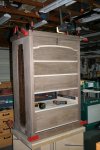
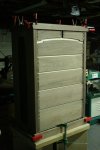
Well, this is a little embarrassing. I expected some screws today and they did not show. Rather than substitute, I will wait for tomorrow so . . . almost all the drawers are in :eek:. The full width drawers are about 29" wide inside and I have some concern about the lower drawers capacity. I have designed them so that if it appears necessary, I can easily remove the bottoms, add a center cleat, saw the existing bottom down and install it as two panels. I don't really see doing this but, wanted to be prepared and not have to 'wing' some sort of a fix later is called for :).

CoD drawers-more (5).jpg CoD drawers-more (6).jpg CoD drawers-more (7).jpg CoD drawers-more (8).jpg

So close . . . . . I really wanted to have all the drawers in today but, I know I'll be happier if I wait.
 
I had a dresser built by a custom place 20 years ago, 32 inch wide drawers and 20 inches deep.
Maple ply with cherry trim, 1/2 inch baltic birch drawers with 1/4 inch bottoms. There has never been an issue with the bottoms, and my wife keeps the bottoms drawers stuffed to capacity.
 
I had a dresser built by a custom place 20 years ago, 32 inch wide drawers and 20 inches deep.
Maple ply with cherry trim, 1/2 inch baltic birch drawers with 1/4 inch bottoms. There has never been an issue with the bottoms, and my wife keeps the bottoms drawers stuffed to capacity.

Good to know Allen. Thanks a bunch for the info. I have shop drawers 24" wide with 1/4" bottoms that are full of more weight than I could ever come up with in clothes. I'm just overly cautious (or just really annoying).
 
I've been in one of those 'lots of effort for little visual progress' phases but, wanted to share (probably just to make myself feel better). All drawers in front and back views:

CoD-all-drawers-frt.jpg CoD-all-drawers-rear.jpg

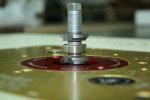
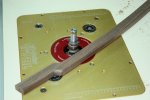
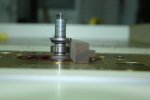
I use so many arched and curved pieces that when routing a profile the ability to route 'downhill' is often a challenge. I came across this bit at a particularly reasonable price and finally picked one up. For the cloud lift trim I can raise and lower the bit to reverse the cutting edge and maintain a 'downhill' path. Anyone who has had a carefully sculpted piece explode on them due to reversing grain patterns can empathize with the pain and delay that this brings.

CoD-dbl-roundover (2).jpgCoD-dbl-roundover (3).jpg

On single face stock it is very handy for doing both profiles at once.

CoD-dbl-roundover (1).jpg
 
If you are lowering or raising the bit doesn't that bring into play the matching of your existing profile on your piece? I would think matching up the transition from top bit cut to bottom bit cut would be difficult. Do you have some method that speeds that along?
 
Very interesting bit. How do the cutters lock in place?

Pressure from the nut just like a slot cutter / stack. I generally assemble the height I am after "pinkie-tight" and then chuck the shaft, put a wrench on the collet and tighten the top-nut.

It appears to me that there are small washers (spacers) between the bearing and the cutters. is this how you adjust the proper spacers then tighten the cutter against them?? :huh:

Correct. The bit comes with a number of duplicate washers of different thicknesses. I usually do very small radii by hand and larger ones with a shave. A good consistent 1/8" is a frequent dimension for me and that is what this bit is. Cutters are available for other radii and you can mix or match.
 
Last edited:
If you are lowering or raising the bit doesn't that bring into play the matching of your existing profile on your piece? I would think matching up the transition from top bit cut to bottom bit cut would be difficult. Do you have some method that speeds that along?

The router lift is very accurate and very repeatable. It is quite easy to move from one height to another and back again -or- back + .006" or - .002". This is especially handy if you are building a profile with multiple bits and have to go back and run another series a couple days after abondoning your setup.
 
Last edited:
Glenn,

You sure make me proud to be your father.

Speaking of fathers, the orangish yellow and black awl was my father's. It is older than I am (87). Isn't it a joy to use an old tool that is in great shape! After my father died, that was my primary (virtually exclusive) awl.

Your post 1-2-12 has the picture. I tried to copy the pic and place it here. However, it did not work.

Enjoy,

JimB
 
I know it has been awhile between postings. I have been busy turning these:

CoD-drawer-fingers 1.jpg

Into these:

CoD-drawer-fingers 2.jpg

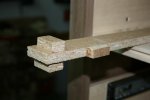
This gives a decent view of the elevations between stiles, dividers and drawer fronts:

CoD-drawer-fingers 3.jpg

The ebony pillowed plugs don't go in until after most of the finish has cured so I have to use my imagination.


5169
 
Last edited:
Top